AOD-9604 Technical Overview
AOD-9604 is a modified fragment of growth hormone. Its sequence, Tyr-Leu-Arg-Ile-Val-Gln-Cys-Arg-Ser-Val-Glu-Gly-Ser-Cys-Gly-Phe, matches the hormone’s 177-191 region with a tyrosine added at the N-terminus.
The cysteine residues at positions 7 and 14 form an intramolecular disulfide bond, which closes the central part of the chain into a cyclic loop. PubChem indexes the compound under CID 71300630, and the literature also uses the research designation AOD9604.
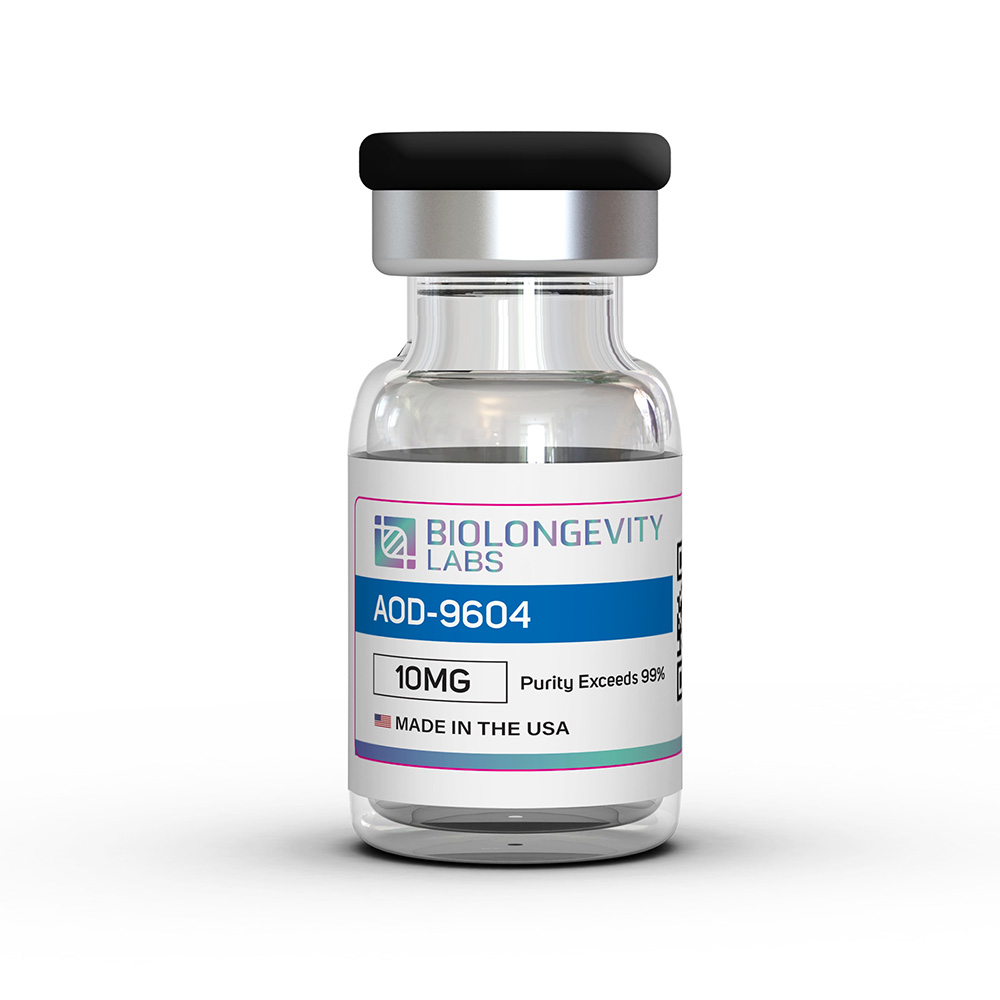
Because of the added tyrosine, AOD-9604 is often listed as a modified hGH fragment 176-191. Laboratory work with the compound centers on adipose tissue lipolysis assays, growth hormone receptor binding studies and peptide stability profiling. BioLongevity Labs offers AOD-9604 for sale strictly as a research peptide.
Compound Specifications
| Property |
Value |
| CAS Number |
221231-10-3 |
| PubChem CID |
71300630 |
| Molecular Formula |
C₇₈H₁₂₃N₂₃O₂₃S₂ |
| Molecular Weight |
1815.1 g/mol |
| Monoisotopic Mass |
1813.8604 Da |
| Amino Acid Sequence (One-Letter) |
YLRIVQCRSVEGSCGF |
| Amino Acid Sequence (Three-Letter) |
Tyr-Leu-Arg-Ile-Val-Gln-Cys-Arg-Ser-Val-Glu-Gly-Ser-Cys-Gly-Phe |
| Sequence Length |
16 residues |
| Disulfide Bond |
Cys7 to Cys14 (intramolecular) |
| Source |
Synthetic (solid-phase peptide synthesis) |
| InChIKey |
GVIYUKXRXPXMQM-BPXGDYAESA-N |
| UNII |
7UP768IP4M |
| Synonyms |
AOD9604, AOD 9604, Tyr-hGH(177-191), modified GH C-terminal fragment 176-191 |
| Strength |
10mg per vial |
| Purity |
≥99% (HPLC) |
| Appearance |
Lyophilized white powder |
| Solubility |
Soluble in DMSO |
| Storage |
-20°C, protect from light and moisture |
Storage and Handling
- Store the lyophilized compound at -20°C, sealed and protected from light and moisture.
- After reconstitution, store at 2 to 8°C and use promptly. Avoid repeated freeze and thaw cycles.
- Maintain aseptic handling to preserve compound integrity.
Lyophilized Format
This compound ships in lyophilized (freeze-dried) form. Freeze-drying supports long-term storage stability and preserves compound integrity. No fillers are added.
Research Use Disclaimer
AOD-9604 is supplied for research use only. It is not a drug, food, cosmetic, or dietary supplement and has not been evaluated by the FDA. By purchasing, the buyer confirms the compound will be used solely for in vitro research.
Frequently Asked Questions
What Is AOD-9604?
AOD-9604 is a synthetic 16-residue peptide made of the 177-191 C-terminal sequence of growth hormone with an added N-terminal tyrosine. BioLongevity Labs supplies it as a 10mg lyophilized powder for research use only.
Is AOD-9604 the Same as hGH Fragment 176-191?
AOD-9604 is closely related but not the unmodified native sequence. It is the 177-191 region of growth hormone with a tyrosine added at the N-terminus, which is why it is often listed as a modified 176-191 fragment.
Does AOD-9604 Bind the Growth Hormone Receptor?
In published binding assays with BaF-BO3 cells engineered to express the growth hormone receptor, AOD-9604 did not compete for receptor binding and did not induce cell proliferation. This separates it from intact growth hormone in laboratory models.
What Is the CAS Number and Molecular Weight of AOD-9604?
AOD-9604 is listed under CAS number 221231-10-3 and PubChem CID 71300630. Its molecular formula is C78H123N23O23S2, with a molecular weight of 1815.1 g/mol.
How Is AOD-9604 Purity Verified?
Each AOD-9604 batch is tested by an independent third-party laboratory to a ≥99% purity specification. The Certificate of Analysis for each batch is published online and can be reviewed before purchase.
Research Overview
Research on AOD-9604 grew out of work that mapped a lipolytic domain to the C-terminal region of growth hormone. A synthetic version of the unmodified 177-191 sequence, designated AOD9401, stimulated hormone-sensitive lipase and inhibited acetyl-CoA carboxylase in isolated rat adipose tissue [1].
In ex vivo assays, the same parent fragment raised lipolytic activity and lowered lipogenic activity in isolated adipose tissue preparations [2]. AOD-9604 adds a tyrosine to the N-terminus of this sequence and is the form studied in the work below.
Three research threads build on this adipose tissue work.
Receptor Binding and Lipid Oxidation
In BaF-BO3 cells engineered to express the growth hormone receptor, AOD-9604 did not compete with labeled growth hormone for binding and did not induce cell proliferation [3]. In ob/ob and lean C57BL/6J mice, 14 days of exposure was associated with higher fatty acid oxidation and plasma glycerol, an index of lipolysis, without the rise in plasma glucose seen with intact growth hormone [3].
In Zucker rats, adipose tissue from AOD-9604 exposed animals showed higher lipolytic activity, and euglycemic clamp measurements showed no change in insulin sensitivity [4].
Beta-3 Adrenergic Receptor Studies
A follow-up mouse study linked these observations to beta-3 adrenergic receptor expression. AOD-9604 raised beta-3 adrenergic receptor RNA in adipose tissue of ob/ob mice to levels comparable with lean controls [5].
In beta-3 adrenergic receptor knockout mice, chronic exposure produced no change in lipolysis, yet an acute experiment still showed higher energy expenditure and fatty acid oxidation [5]. The authors concluded that the lipolytic activity is not mediated directly through this receptor, although receptor expression may add to lipolytic sensitivity [5].
Cartilage and Analytical Research
AOD-9604 has also been examined in a collagenase-induced cartilage degeneration model in rabbits. Intra-articular application, alone and with hyaluronic acid, was associated with lower gross morphological and histopathological cartilage scores than saline controls [6].
Analytical work incubated AOD-9604 in serum and urine and identified six metabolites. One fragment with the sequence CRSVEGSCG was markedly more stable than the parent peptide or the other metabolites [7]. A separate study reported that AOD-9604 does not influence a growth hormone isoform immunoassay [8].
| Research Area |
In Vitro Application |
| Adipose Tissue Lipolysis |
Hormone-sensitive lipase activity and glycerol release assays in isolated adipose tissue |
| Lipogenesis |
Acetyl-CoA carboxylase activity and lipogenic assays in adipose tissue preparations |
| Receptor Binding |
Competitive growth hormone receptor binding and proliferation assays in BaF-BO3 cells |
| Adrenergic Signaling |
Beta-3 adrenergic receptor RNA expression studies |
| Peptide Stability |
Serum and urine incubation with metabolite profiling |
| Analytical Methods |
Solid-phase extraction method development and immunoassay cross-reactivity testing |
References
- Ng FM, Jiang WJ, Gianello R, Pitt S, Roupas P. (2000). Molecular and cellular actions of a structural domain of human growth hormone (AOD9401) on lipid metabolism in Zucker fatty rats. Journal of Molecular Endocrinology. https://doi.org/10.1677/jme.0.0250287
- Heffernan MA, Jiang WJ, Thorburn AW, Ng FM. (2000). Effects of oral administration of a synthetic fragment of human growth hormone on lipid metabolism. American Journal of Physiology. Endocrinology and Metabolism. https://doi.org/10.1152/ajpendo.2000.279.3.E501
- Heffernan MA, Thorburn AW, Fam B, et al. (2001). Increase of fat oxidation and weight loss in obese mice caused by chronic treatment with human growth hormone or a modified C-terminal fragment. International Journal of Obesity and Related Metabolic Disorders. https://doi.org/10.1038/sj.ijo.0801740
- Ng FM, Sun J, Sharma L, Libinaka R, Jiang WJ, Gianello R. (2000). Metabolic studies of a synthetic lipolytic domain (AOD9604) of human growth hormone. Hormone Research. https://doi.org/10.1159/000053183
- Heffernan M, Summers RJ, Thorburn A, et al. (2001). The effects of human GH and its lipolytic fragment (AOD9604) on lipid metabolism following chronic treatment in obese mice and beta(3)-AR knock-out mice. Endocrinology. https://doi.org/10.1210/endo.142.12.8522
- Kwon DR, Park GY. (2015). Effect of Intra-articular Injection of AOD9604 with or without Hyaluronic Acid in Rabbit Osteoarthritis Model. Annals of Clinical and Laboratory Science. https://pubmed.ncbi.nlm.nih.gov/26275694/
- Cox HD, Smeal SJ, Hughes CM, Cox JE. (2014). Detection and in vitro metabolism of AOD9604. Drug Testing and Analysis. https://doi.org/10.1002/dta.1715
- Orlovius AK, Thomas A, Schänzer W, Thevis M. (2013). AOD-9604 does not influence the WADA hGH isoform immunoassay. Drug Testing and Analysis. https://doi.org/10.1002/dta.1557
Certificate of Analysis (COA)
No COAs available for this product.
A Certificate of Analysis (COA) is a document that verifies a compound’s identity, purity and quality through independent laboratory testing. Every compound from BioLongevity Labs is third-party tested, and its COA is published here, so researchers can review the testing record before a compound enters a protocol.
Each COA reports results from third-party laboratory analysis, including:
- Ultra-high-performance liquid chromatography with mass spectrometry (UHPLC-MS) for purity, measured against a 98% or 99% specification depending on the compound
- Mass identification for molecular confirmation and content quantitation
- Endotoxin testing by Limulus amebocyte lysate (LAL) or recombinant Factor C (rFC) assay, depending on the laboratory
- Visual and physical characterization of the finished material
How to Verify a COA Independently
You can check every certificate against the issuing laboratory’s own records, not just the copy hosted here. Verification does not depend on BioLongevity Labs.
- AV Analytics certificates carry a search code. Scan the QR code on the certificate to open the laboratory’s verification page, or enter the search code at avanalytical.com/coa-search to pull the official record.
- BioRegen reports of analysis carry a Report ID and a Validation Key. Scan the QR code on the certificate to open the official record, or quote both identifiers when you contact the laboratory at the address printed on the report.
- SafeCert Labs issued a number of earlier certificates. Each one carries a COA number and the signature of the reporting chemist. Quote that number when you ask the laboratory to confirm it.
- Older certificates from other laboratories list their own verification details on the document.
When a batch is sent to more than one laboratory, each certificate resolves at its own issuing laboratory. A researcher can then check the results against two unrelated sources.
These COAs come from independent certified laboratories, not in-house testing. That gives researchers a verifiable record of molecular integrity for each compound. All compounds are supplied for research use only.
Review the latest COAs for this product below, or browse the full COA library.